
Introduction
Meal prepping — the practice of preparing food in advance for the week ahead — has become enormously popular globally as a strategy for eating healthier, saving money, and reducing the daily stress of deciding what to cook. While meal prep is often associated with Western food cultures and gym-focused eating plans, it is equally applicable and arguably even more natural in the context of Indian cooking.
Many traditional Indian cooking practices — making large batches of pickle that last for months, preparing idli-dosa batter to last the week, cooking a big pot of dal that serves multiple meals — are essentially meal prep. This guide shows you how to apply systematic meal prep thinking to an Indian dietary context.
Why Meal Prep Works for Indian Food
Indian food is particularly well-suited to meal prepping for several reasons. Many Indian dishes actually improve over time as flavors develop — dal, khichdi, curries, and especially biryani taste better the next day.
The spice-heavy nature of Indian cooking means that even reheated dishes retain much of their flavor and aroma. Indian cooking also naturally revolves around a base of rice and roti (which can both be prepped in advance), making it easy to vary meals throughout the week by changing the accompanying dal or sabzi while keeping the grain base consistent.
The Foundation — Cooking Rice and Roti in Advance
Rice keeps well in the refrigerator for 4-5 days and can be reheated with a splash of water in the microwave or on the stovetop. Cooking a large batch of rice on the weekend — 3-4 cups of dry rice — sets up the grain base for multiple meals.
For roti, there are two approaches: either make the dough in advance (it keeps refrigerated for 2-3 days), rolling and cooking rotis fresh each morning (which takes only 15 minutes), or cook the rotis fully in advance and stack them wrapped in a clean cloth or foil (they keep well for 2-3 days and reheat beautifully on a hot tawa). Both approaches are used by busy Indian families and work well.
Weekly Dal Prep
Dal is the cornerstone of the Indian meal prep strategy. Cooking a large batch of dal once or twice a week is perhaps the most efficient single meal prep action you can take. A dal that takes 45 minutes to cook properly can serve 6-8 people for 2-3 meals.
Toor dal with tomato and basic spices, or a mixed dal of toor and masoor, are excellent base dals that can be customized at serving time with different tadkas (temperings). The dal keeps refrigerated for 4-5 days and freezes well for up to 3 months. Rotating between different dal varieties through the week provides nutritional diversity.
Batch Cooking Vegetables
Vegetable preparation is often the most time-consuming part of Indian cooking. Batch prepping vegetables saves significant time during the week. Peel and cut onions in bulk — they keep well in the refrigerator for 5 days.
Make ginger-garlic paste in a food processor and store in an airtight jar in the refrigerator (it keeps for 2 weeks). Blanch and portion spinach or other leafy greens that can be added to various dishes. Roast a large tray of mixed vegetables (cauliflower, carrots, potatoes, capsicum) seasoned with turmeric and spices — these can be used across multiple meals as a sabzi, added to rice, or folded into parathas.
A Sample Weekly Indian Meal Prep Plan
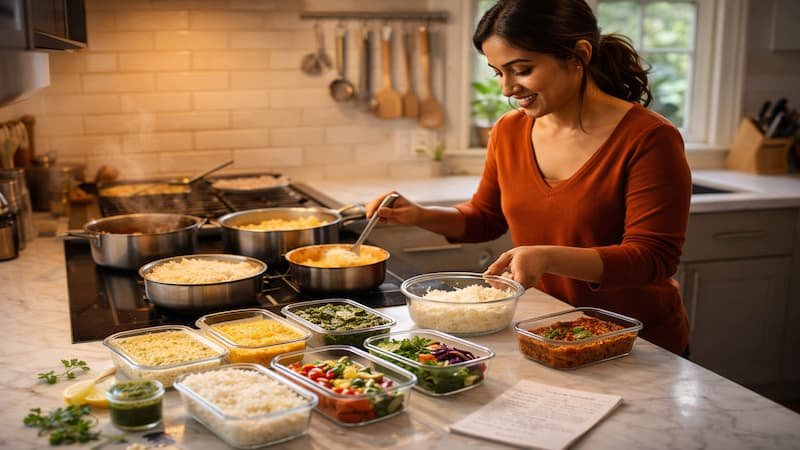
Sunday Prep Session (approximately 2.5 hours): Cook 4 cups of basmati rice. Make toor dal and masoor dal (two different flavors). Prepare a large batch of ginger-garlic paste. Cut and refrigerate onions, tomatoes, and other vegetables for the week.
Prepare and refrigerate idli-dosa batter for fermentation. Boil eggs if desired. Make one sabzi — perhaps aloo gobi or palak paneer. This Sunday prep provides the foundation for 5 days of varied, healthy Indian meals requiring only 15-20 minutes of cooking each day for final assembly and fresh elements like roti.
Smart Storage for Indian Food
Proper storage is essential for successful meal prep. Glass containers with airtight lids are superior to plastic for storing Indian food as they do not absorb odors or stains from spices and tomatoes. Store dal and curries in 2-portion containers for easy grab-and-reheat access.
Keep raw prepped ingredients (cut vegetables, marinated meat, fresh masala) separate from cooked items to prevent cross-contamination. Label all containers with the date prepared. Freeze portions of dal, curry, and cooked rice in portion-sized ziplock bags lying flat — they freeze and thaw more efficiently than thick containers.
Reducing Food Waste Through Indian Meal Prep
One of the most significant benefits of systematic meal prep is the dramatic reduction in food waste. When you plan your meals for the week and shop accordingly, you buy exactly what you need. Day-old rice becomes the basis for fried rice or khichdi.
Leftover dal can be used as a thick dip for bread or stuffed into parathas. Extra cooked vegetables can be turned into a sabzi or added to an egg dish. A systematic approach to planning and using every ingredient is deeply embedded in traditional Indian household food culture and is one of the most economically and environmentally responsible ways to eat.
Conclusion
Indian meal prep is not about eating the same thing every day — it is about establishing a system that makes it possible to eat varied, freshly combined, nutritious Indian meals every day without the daily burden of starting from scratch. By prepping the foundations — rice, dal, base masala, cut vegetables — you give yourself the building blocks to quickly assemble many different meals throughout the week.
The combination of traditional Indian culinary wisdom and modern meal prep strategy creates a sustainable, delicious, and nourishing way of eating that fits the demands of contemporary life.