
Introduction
Indian cuisine is one of the oldest, most sophisticated, and most influential in human history. Its roots stretch back over 5,000 years to the Indus Valley Civilization, and its evolution has been shaped by invasion, trade, religion, geography, and the extraordinary diversity of the subcontinent’s peoples and cultures.
To understand Indian food is to understand Indian history — every significant historical event, from the arrival of the Mughals to the spice trade with Europe, left an indelible mark on the Indian plate. This article traces the fascinating history of Indian cuisine from its ancient origins to the globally influential food culture it is today.
Ancient Origins — The Indus Valley Civilization
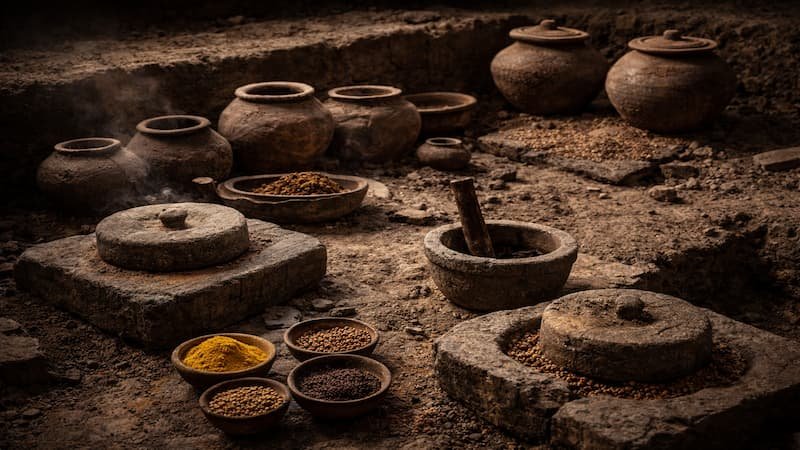
The story of Indian food begins with one of the world’s earliest urban civilizations. Archaeological excavations at Mohenjo-daro and Harappa (in present-day Pakistan and northwestern India) have revealed evidence of sophisticated food systems dating back to 3000-2500 BCE. Researchers have found traces of turmeric, ginger, garlic, and mustard at these sites — spices that remain fundamental to Indian cooking today.
These early inhabitants grew wheat, barley, rice, lentils, and chickpeas, and raised cattle, pigs, and poultry. The evidence suggests a highly organized food culture with standardized weights and measures for trade.
Vedic Period (1500-500 BCE) — Food as Sacred Ritual
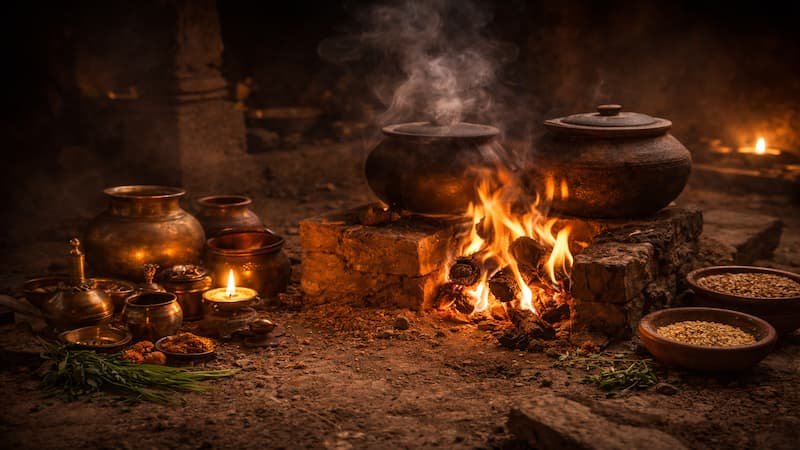
The Vedic period, during which the oldest Hindu texts (the Vedas) were composed, established food as a central element of religious and social life. The concept of ahimsa (non-violence) began to influence food culture, though vegetarianism was not yet universal. The texts describe detailed systems of food preparation and consumption, including the concept of samskar (refinement) applied to food.
Grains, dairy, honey, and fruits were particularly revered. Many modern Indian food traditions — including offerings to gods (prasad), the sacred status of the cow, and the Ayurvedic classification of foods — have their roots in this period.
Buddhist and Jain Influence — The Vegetarian Revolution
The rise of Buddhism and Jainism in the 5th-6th centuries BCE had a profound and lasting impact on Indian food culture. Both traditions emphasized ahimsa (non-violence) and advocated for vegetarianism. The Buddhist emperor Ashoka (3rd century BCE), who converted after the bloody Kalinga war, promoted vegetarianism and banned the slaughter of many animals.
Jainism took non-violence even further, prohibiting not only meat but also root vegetables (considered to destroy entire organisms when harvested) and foods prepared or consumed in ways that might harm insects. These traditions established the rich vegetarian cooking tradition of India that continues to this day.
The Spice Trade — India’s Gift to the World
For most of recorded history, India was the world’s primary source of spices, and the spice trade shaped the global economy and the course of world history. Pepper, cardamom, cinnamon, turmeric, ginger, and cloves from India were among the most valuable commodities in the ancient and medieval world, commanding prices higher than gold in European markets.
The desire to find direct sea routes to India to bypass the Arab middlemen who controlled overland spice routes was the primary motivation for the European Age of Exploration — Columbus was looking for India when he discovered America. The Portuguese, Dutch, and British colonization of much of Asia was driven by the desire to control the spice trade.
Mughal Influence — A Culinary Revolution
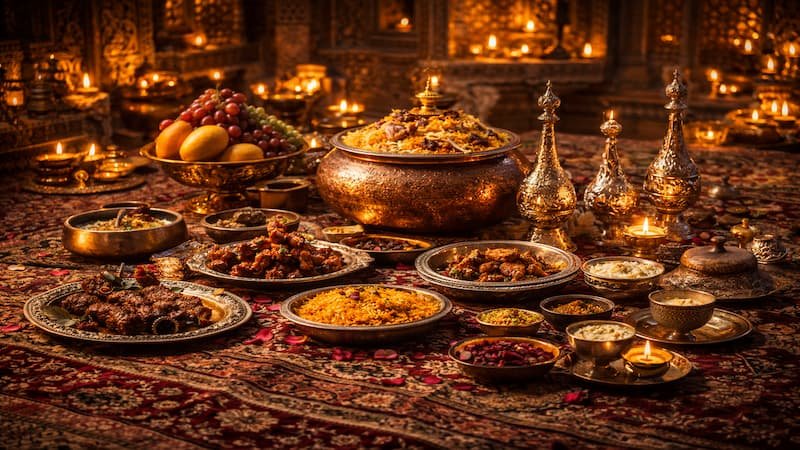
The Mughal Empire (1526-1857) had perhaps the most dramatic single influence on North Indian cuisine. The Mughals brought with them Persian and Central Asian culinary traditions characterized by the use of meat (particularly lamb and poultry), dry fruits, nuts, saffron, and complex spice blends. They also brought sophisticated cooking techniques including dum cooking (slow steam cooking) and tandoor cooking.
The magnificent court cuisine of the Mughal emperors gave birth to many of India’s most celebrated dishes: biryani, korma, qorma, kebabs, and the rich gravies of the Mughal table. The fusion of Mughal and indigenous Indian culinary traditions created the distinctive North Indian food culture.
Portuguese and Colonial Influences
European colonialism, particularly Portuguese presence in Goa from 1510, introduced new ingredients that transformed Indian cuisine. The Portuguese brought chili peppers from the Americas to India — an event that fundamentally changed Indian cooking forever. Before chilies, Indian food was spiced primarily with black pepper, ginger, and long pepper.
The introduction of tomatoes, potatoes, corn, and cashews from the New World also dramatically expanded the Indian culinary palette. Goan cuisine, with its distinctive combination of Portuguese, indigenous Konkani, and Indian elements, is the most vivid expression of this colonial culinary fusion.
Modern Indian Food — Global and Glocal
Contemporary Indian food is the product of all these historical influences: ancient Indus Valley food wisdom, Vedic and Ayurvedic traditions, Buddhist and Jain vegetarian philosophy, regional diversity, Mughal sophistication, and colonial introductions. Today, Indian cuisine is one of the most globally popular food cultures — Indian restaurants exist in virtually every country, and dishes like chicken tikka masala, butter chicken, and biryani have become part of the global culinary mainstream.
At the same time, within India, traditional regional food cultures — the extraordinary seafood cuisines of Kerala and Goa, the subtle flavors of Kashmiri cooking, the sophisticated vegetarian traditions of Rajasthan and Gujarat — continue to thrive.
Conclusion
Indian food is a living archive of human history — every dish tells a story, every spice blend reflects a cultural encounter, every cooking technique embodies centuries of refinement and wisdom. Understanding the history of Indian food enriches the experience of eating and cooking it, transforming everyday meals into acts of connection with an extraordinarily rich human heritage.
The next time you eat a bowl of dal or bite into a samosa, you are participating in a culinary tradition that stretches back thousands of years.